Grief Loss and Bereavement


風雨蘭 Zephyranthes macrosiphon 花朵

Image by 澎湖小雲雀 via Flickr

Newsweek online has a regular feature called My Turn where ordinary people submit essays on topics they are passionate about in hopes of seeing them published to be shared with others. Recently I read an essay by Jess Decourcy Hinds, a twenty-five year old college writing instructor, on the do’s and don’t’s of expressing condolences to the grieving. Ms. Decourcy Hinds lost her father a year ago to cancer. Although she was concerned with society’s tendency to hurry the grieving through the “process” and back to a state that makes everyone but the bereaved person more comfortable, she was truly torqued about the way people phrase their expressions of sympathy. Her essay reminded me a bit of a list that circulates with regularity on the YWBB which is meant to help the non-widowed avoid irritating the widowed with their well-intentioned, but basically clueless and clumsy, attempts to help us feel better.


There are all sorts of pat phrases that the newly bereaved will hear during the first hours to months after a loved one dies. Frankly, I don’t recall all the platitudes that I know were offered up to me as balm for my seared soul. The only one I do recall that I still take great issue with is “I understand how you feel” because few people do unless they have been widowed themselves. I only understand bereavement from my own perspective and suspect that I am not alone in this. A point that I think would be lost on the author of this article. My parents are still alive. I haven’t lost a sibling. Though I did lose children to miscarriages, I have not lost a baby or a child. I don’t know what that would feel like. I don’t know how I would react for sure. I do know that based on how it felt to watch my husband slip away from me over months and years and then die, that I can’t imagine the pain of other types of loss of loved ones, and this is mostly because I don’t want to. I have enough pain and memories of pain without imagining losses that have yet to or may never occur in my lifetime. I am honest now when I express my sympathies to those newly laid low by grief. I am very sorry for the pain they must be feeling, and I really can’t imagine what it must be like.


A good friend from many years back lost her son when he was just a bit younger than my daughter. He was murdered by her now ex-husband. We have fallen out of touch over the years and those times when we have reconnected, we haven’t discussed him. Since that time she has moved forward, married again and has a little boy who is two years younger than my Dee, and I have lost a husband. The one time we did tiptoe around the edges of our losses, we both came to the agreement that there is no road map for grief. No handbook to follow. And we are left to struggle through as best fits our needs. I think that probably this can be said of those around us as they grope for words of sympathy. Because it is sympathy they are expressing, not empathy. They don’t know.
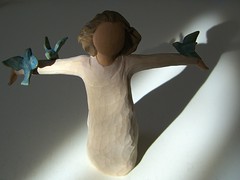


Happiness

Image by 4nitsirk via Flickr

From time to time the topic of choice comes up on this grief journey. There is a camp, and I fall squarely into it, that believes that happiness is something you choose. The other side of the coin is the belief that you cannot make yourself “get happy”. The reality, as it often does, lies somewhere in between the extremes. I made the choice to be happy again long before Will died. Happiness has always been the light at the end of my tunnel. If it hadn’t been there. If I couldn’t believe in it. I wouldn’t be here right now. So in some ways it is rather simple. But, in others, it is not. I didn’t wake up happy one day. My decision to pursue happiness actively didn’t get me to the state of bliss quickly. Indeed, I would say that though much of my life is on track and I am quite happy with where I am heading, there are still pieces of the puzzle out of place or missing altogether. The idea that happiness is achieved simply by the act of making the choice is one that is most common in those who refuse to choose. Those of us who have chosen, know better.


Happiness is not handed to anyone. There is work involved and in the beginning as many setbacks as there are steps forward. The happiness seekers are criticized for wanting to distract themselves from their grief or avoid it altogether. It’s not possible to do this however. You can’t make the milestones and memories disappear. When I sold the house, it brought out of the shadows the memories of that summer we bought it. Of Will’s rapid descent into dementia. Of learning he was terminal. All the financial difficulties. Worry about how I would care for a dying man and a not quite toddler and still hold down a full time job because we needed the money and the health insurance. I am planning a major move and preparing to marry. I don’t need to go back there right now, but I do. Those memories would have stayed put otherwise. And you might ask, what does that scary time and sad, painful memories have to do with happiness? Aside from provide a contrast? They are a reminder not to take now for granted. To be thankful for the love I have found with Rob and the life we are starting. Because grieving is not just about leaving someone behind, it is also about taking stock of where you are and deciding where you want to be. Some of us decide that where we want to be is stuck. More of us, I think, choose to push through and pursue a course that, though harder at times, is ultimately more rewarding. Grief work is not about wallowing. It is about living. And if that sounds simplistic, it is because most things in life are rather simple. It is we who complicate matters with over-analysis and supposition.


“Thinking makes it so” is what I believe Shakespeare wrote in his ode to being stuck in grief, Hamlet. I never have liked that play. I loathe the character of Hamlet. I had a professor in a summer humanities course who waxed endlessly about the intricacies of the character and the profundity of his thought processes. I just saw someone who was more content in rationalizing and second guessing because it was safe. In the great “to be or not to be” soliloquy, Hamlet ponders the question of seeking refuge in death and wonders why he cannot. He surmises that it is the dilemma of trading the known for the unknown. It is the same for those mired in grief. To make a decision to seek happiness is to trade the safety of your known misery for the uncertainty of finding a life beyond it and in seeking happiness, end up more miserable.


When you choose to be happy, you are in no way guaranteeing that happiness will be the outcome. Too many variables. However, in not making the choice you are assuring that you won’t be.


Photo of Jacqueline Kennedy, Robert Kennedy, J...

Image via Wikipedia

I wonder if Jackie Kennedy wrote all her own thank you cards in the days after her husband’s murder? I imagine she did. Perfect widows write thank you’s to everyone who express even the most rudimentary acknowledgment of their loss. Perfect widows don’t make any important decisions during the first year. They don’t date. They live only for their children, who represent the only reason for rising in the morning, and they adhere with the fervor of a convert to the stages of grief. Following them lock-step through that first year, the perfect widow is all about preparing herself for that second year, which she expects to be only occasionally as awful as the first, but certainly as melancholy.

I am so not the perfect widow. And it goes well beyond the fact that I didn’t write a single thank you card. As a matter of fact after I shook the cash out of each card, like my four year old does whenever she receives mail of any kind, I put the cards in a bag and never took them out again. I don’t think I even read any of them. I needed the money to pay for my husband’s wake and to bury him, but I had no use for expressions of sympathy from people who had ignored, abandoned or treated my daughter and I as inconveniences during the two and a half years we watched Will die.

When I say “we”, I mean that almost literally. It was just she and I most of the time. There were a few people who stuck close and were beyond helpful and generous, but very few.

I am continually floored by the Grief Rules mavens who seem to think that being widowed entitles them to bully all others into accepting their interpretation of bereavement. I am make no claims to wallflower status myself when it comes to expressing an opinion, but I would hope that no one ever felt as though I was telling them how to mourn from my perch high atop Mt. Perfection.

It shouldn’t surprise me that people seem to possess a fair amount of entitlement when it comes to having their tokens of sympathy acknowledged. It seems that we are not able to simply do the right thing by family, friends and neighbors without being handed a gold star to wear in return. To my mind, sending flowers or food or cards is for the comfort of the bereaved person and never done in expectation of acknowledgment of any kind. I can’t recall exactly the chapter and verse (I am a Catholic after-all) but I am sure that Jesus had something to say about those who needed to have their good deeds and pious ways well published.

There is no right or wrong when it comes to surviving the death of your spouse. Because it is about surviving with the hope of one day moving forward and living again. It is in this way that we honor them and not through the writing of thank you cards.