On Saturday, January 20th, women marched. Again. With them were men and children, friends, neighbors, coworkers, strangers. People with whom they agreed on varied issues, and people they didn’t agree with so very much.
Women all over North America planned and organized marches and rallies that drew millions in total.
But not everyone saw the point.
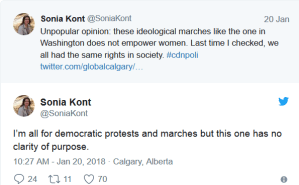
There is a lot to unpack in those few sentences, and between their lines, but we’ll stick to the words.
In the United States, unlike Canada, women are not specifically included in the Constitution or The Bill of Rights. An attempt was made to add women as women rather than “all men” back in the 1970’s, but anti-feminists successfully fought that in a lengthy state by state battle, and it’s not been revisited since.
Women’s rights in the US are largely a series of court rulings, between the line readings of the Constitution, and individual pieces of legislation that are only as good as those willing to enforce them. They exist on paper but could disappear with the stroke of a pen.
Men and women have always had the same right to rights, but the reality is that women’s access is fairly new and not everyone is keen about that.
The election of an openly sexist man to the Presidency of the United States, the most powerful nation in the world, was a wake up call. Complacency, which should never have been an option, cannot be a comfy corner of denial any longer.
And women marched. It was a rallying point. One that has launched more women than ever into politics and activism.
There isn’t a single purpose because women’s lives are made up of more than single issues, but there is an overarching theme. Time’s up.
Time is up on sexism in the workplace, education, religions and their institutions. No more hiding behind reasons that never made any sense or had much validity in the first place.
Time is up on misogyny. The casual violence of words used to silence, defame and wound. The physical violence that is still too often dismissed or ignored. The use of sex as a weapon to demean, instill fear, and dominate.
Time is up on the exclusion from politics and governance via systemic sexism which everyone can plainly see, but even in 2018, we still accept for reasons that have no validity if we really do believe that men and women have the same rights.
It takes fire in the belly to organize a march once, but doing it a second time requires clarity. Acknowledging that a year has gone by with successes and failures and with still much to be done. Being able to create an atmosphere that allows anyone who wants to participate the space to do so.
Organizers and marchers, by the millions, all across the continent showed up, marched, spoke, connected and became for a moment in time peaceful communities. They acknowledged each other and the importance of the many aspects of democracy and community activism they’d been involved in since the last march. To insinuate this lacked clarity is a bit of an insult.
But I understand where that impulse to dismiss comes from because once upon a time, I shared a disdain for the need to be a feminist. I wouldn’t call myself one. I played that silly word game of “I believe everyone is equal, but I’m not a feminist”. Except I was.
I can think of dozens of examples in grade school alone where I all but stood atop a desk and declared war on Sr. Walter Marie’s attempts to make a “proper lady” of me. I could never have been other than a feminist.
But as a young woman, all I could see was the hard work of being a feminist compared to the seemingly more cushy existence of not, and it wasn’t until I was out working on a career and running into roadblocks that my male peers weren’t that it dawned on me that feminism was just this. It was the blatant unfairness of being passed over for jobs that I was the most qualified for in favor of a male colleague who golfed with the principal or coached the football team of a superintendent’s son. There were too many boys’ clubs in too many aspects of life and being the most accomplished or hardest worker was never going to grow me the penis I needed for entry.
Privilege, and I never forget that I have a lot of it these days, makes agnostics of many. The need to believe and fight isn’t so much when bias and bigotry don’t affect your existence all that often. And so many girls are still brought up as objects rather than individuals with dreams and talents of their own that the acceptance of everyday sexism has to reach deafening levels to break through that training.
It’s hard to understand, but there are women who preferred the old way because they believed it benefited them more, and they were willing to make the compromises and personal sacrifices to play along with that game. There are still women who are fine with it and would like to turn back the clock regardless of how that affects other women.
In North America, we like to say that we all have the same rights. We are all equal in the eyes of the law. We all have the same opportunities. Even though we know this isn’t always true because of bigotry and bias, we are mostly united in the belief that we are striving towards that and making good progress.
The Women’s March was born out of the angry realization that we’d erred in our belief that good progress was good enough.
Women’s March of 2018 was clearly stating that we know there is more to do, and we are still committed to doing it.


 anniegirl1138