There are studies showing the effect of care-giving on spouses, and they aren’t pretty. But they miss the heart of why it sucks to be the spouse of someone who’s dealing with a severe illness, no one is interested one whit in how they feel or how they are doing.
While healthcare professionals of questionable intellect, and dubious interest, carted Rob thither and yon today as though he were just another carcass, I rated nowhere near as important as meat on a rolling slab.
Never did I even see a doctor. The only nurses I encountered either ignored me or made it clear that I was wasting their time, though I can honestly say I didn’t see a single nurse above LPN status doing anything other than visiting with other staff members.
Granted, I was not ill. Rob was ill and seriously so with blockage that required a stent to correct. But I count. Regardless of my healthy status, I am deeply affected by anything that threatens my husband’s life and having had one die on me already, I have no illusions about it being impossible a second time.
Dr. Fortune Cookie had come and gone by the time Dee and I reached The Fort Hospital, a place I hope to never have to utilize again because there are one, maybe two tops, nurses on staff who seem to have any idea whatsoever of what is going on.
Exaggerate? Not I.
The nurse who helped load Rob up for his trip to the Royal Alexandria Hospital in Edmonton didn’t know that Dr. Fortune Cookie hadn’t shared any of Rob’s test results with Rob or me and that I had never even spoken to the doctor. She was slightly (emphasis on slight) surprised to find that neither Rob nor I had any idea of what test he was going to have once he got there or that we would even want to know that.
Earlier I’d asked Rob if it was typical of Alberta doctors to not bother to discuss things like what’s wrong with you or treatment options with patients and their families.
“It’s the nanny state in action,” he said. “We simply surrender to the void.”
Void is a good word for it.
Dee was a weepy mess by the time the EMT’s had loaded Rob onto the ambulance. As she and I stood there at the back of the ambulance bay waving goodbye, one of them jumped out and gave her a teddy bear – she was that distraught and I could tell it was making the EMT’s uncomfortable.
To their further credit, the EMT in charge attempted to explain Rob’s labs to me and update me on the angiogram he would be having.
EMT’s are apparently not required to take the same “patient’s and their families are incidental to the great health care process” course that RN’s and Doctors receive in the Great White Socialized Medicine North.
And I am not knocking the idea of universal heath care in general. Rob and I will never see a bill regarding his heart attack, treatment or follow-up care, but the system only sorta works. And the people who make it run on a nuts and bolts level are as big a part of the problem as the politicians who continually under-fund and slash health care budgets.
Half way to the hospital, my cell rang – and yes, I answered it because my husband who just had a heart attack was having an angiogram and god only knew what else because I sure hadn’t been briefed.
It was the nurse at the cardio-cath lab. Rob had asked her to call and give me an update. She told me that he was just going in and that the procedure would take 45 minutes to an hour and that we could see him after at the Digital Imaging Recovery Unit. She even gave me directions.
She would turn out to be the ONLY one who told me anything.
Dee and I found Edie and Mick in the waiting area. We dutifully waited for close to an hour before I questioned the receptionist – who unsurprisingly didn’t know squat. Couldn’t even find Rob’s name on the list of scheduled procedures and just waved me toward the recovery unit with instructions to “ask someone there”.
Just a note about the reception desk at the Royal Alec imaging wing – it says “someone will be with you shortly”. Dee, Edie, Mick and I came in and sat for nearly an hour – were they only ones there – and the dimwitted receptionist never once asked if she could help us or who we were waiting on. Perhaps it is not her job, but it is the only waiting area for non-patients in that area.
Not only that, the doctors who treated Rob didn’t come out after the angio to let us know that it was over and that all was well.
I was told by the two nurses behind the desk in recovery that Rob was on his way to admittance.
“He’s being admitted?” I asked. I’d been told he would go back to the Fort Saskatchewan hospital – even if they ended up treating him. “Why?”
No reason was given and they dismissed me with instructions to meet up with my husband in admitting.
Needless to say, he wasn’t there. But a kindly young registrar made a couple of phone calls and at least tracked down his unit and room number for us.
Of course when we got to Unit 24 – the cardiac wing – he wasn’t there either.
And the nurses chattering happily away to each other behind the desk were in no mood to make a quick phone call to see where he was or if he’d come through the angio okay or if he was being admitted because something further was amiss or had gone wrong or he was going to need surgery.
Do I sound frantic? Ready to drop-kick lazy nurse ass all over Unit 24? Because I was.
“Go down and wait by the elevator,” the nurse waved me off like Queen Elizabeth shooing the help away. “He has to come that way sooner or later.”
And so I paced and was furious – mostly because I was worried.
I still didn’t know what had caused Rob’s heart attack, the extent of the damage, what the treatment would be, how long he’d be in hospital. Nothing.
36 plus hours after he landed in the emergency room at Fort Saskatchewan Hospital and going on four hours into his disappearance into the bowels of the Royal Alec in Edmonton and I knew exactly nothing. Had spoken with not a single doctor and been treated like a nuisance by all but one nurse – and she was the first one back in the Fort ER on Thursday morning, an exceedingly kind woman who answered questions and treated us like people.
The girls offered to go on the hunt for their father. It beat waiting and watching me pace in a futile attempt to quell the rising tide of fury and fret.
They’d been gone about ten minutes when Rob arrived.
He looked better than he’s looked in weeks – all summer really – and I was in such a tizzy all I could do was hiss at the women pushing his bed.
Where had Rob been? What happened? And didn’t anyone think I needed to know any of this?!
I wanted information. I cannot deal with being marginalized and treated as though what ails Rob has zero effect on me. The bed-pushers patted my head – which did nothing to improve my mood – and move on into the now off-limits ward.
Rob had no idea I hadn’t seen a doctor after his procedure by the way. He planned to call my cell if I wasn’t on the unit, forgetting, of course, that I had taken his phone before they hauled him into the city. He was actually expecting to see us there and was confused by the fact that I was upset.
The unit had closed for its two-hour “silent time” when I noticed that every patient who was ambulatory or allowed a wheelchair fled to havens unknown.
The girls arrived and as they were planning to head to the family reunion if the news was positive, they needed to see Rob pronto. It’s a long drive north and they were already under the gun to arrive before the sun set.
I sent them in despite the “closed” sign.
“Just look menacing,” I said. “No one will shoo you off then.”
I was past menacing, in case you missed that. I radiated displeasure and staff that went in and out, ducked their heads and scuttled around my pacing dervish self.
At that point, I wouldn’t have spoken to anyone had someone bothered to approach me with information. In fact, when Dee and I finally saw Rob – almost two hours after our brief reunion in the hall – I ignored the nursing staff entirely. I’d taken the information that Rob had given me and called my BFF in the states. She is a home health care nurse, and she filled the details in for me.
Dee and I visited only a little while with Rob. He was tired. Hungry too because Dr. Fortune Cookie had needlessly starved him with a clear liquids diet back in the Fort – it wasn’t necessary for his procedures. And Dee and I were worn to a nub with waiting.
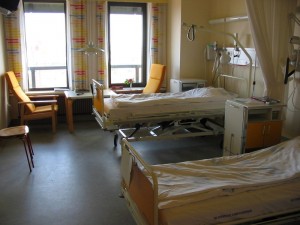
They put Rob in one of those horrid little quad wards that I noticed on a previous visit to the Royal Alec. I think it’s an English thing. They remind me of the psych ward Will ended up on before the doctors finally admitted that I was right and they were wrong and stopped treating my late husband’s illness as mental.
Which brings up the bigger point. Although my Canadian experience was worse, in some respects it runs par with what I encountered in the early days of Will’s illness back in the states. I was ignored and made to feel as though my stake in what was going on was negligible. My spouse’s illness was none of my business because it didn’t affect me.
And to that I say – “like hell”.
“If I ever get sick,” I told Rob, “do not ever bring me to this place.”
“Stop, ” he admonished. “That’s not being very yoga.”
“No,” I said, “it’s not at all and I don’t care.”
“All that ground lost,” and I could see he was trying to get me to smile – and after a while I did – but I still will never willingly be a patient at the Royal Alec.
The least scungy looking areas in the Royal Alec are the main atrium and the food court. Everywhere else: the wards with their double and quadruple occupancy rooms, the nurses stations, the Digital Imaging Recovery Room – every washroom I was forced to use – ooze age in a weary day labourer pushing past middle age kind of way.
A person could be coerced to look beyond appearance if the personnel exuded dedication and love of what they do, but generally, they came off as utterly uninterested in patients beyond what they needed to do in order to get paid, and they reacted to families like they were bad smells.
Ask a question? At best you’ll draw a blank stare and at worst a suggestion that perhaps you go bother someone else. Somewhere you will have to hunt for and walk such a distance away from the first person you queried that you won’t have the energy to double back to the unhelpful sot who knowingly sent you on a snipe hunt.
And back to the doctors. I am still not convinced they do anything other than phone in and it’s even possible they are urban myths.
The most important thing in the end is that Rob is going to be okay, and that he won’t be trapped in that disappointing, underwhelming medical experience for too long.

 periodic dress rehearsals in my daydreams.
 anniegirl1138