Consumerism


Cover of "THX 1138 (The George Lucas Dire...

Cover via Amazon

Science fiction horror scenarios spring from the basic premise that too much technology will eventually enslave us as opposed to liberate or make us better people. The Dune universe was a direct result of a world where computers took over and subjected human beings. George Lucas‘s THX1138 envisioned a world of people in the thrall of television and consumerism that drove people to numb themselves with antidepressants.

And then there was Logan’s Run, where babies were chipped at birth and their every movement monitored until they reached the useless age of 30 and were dispatched for the amusement of others.

Today people willingly tag themselves with GPS enabled phones that they delude themselves into believing are helpful tools. They are aided and abetted in their fantasy by apps.

There’s an app for everything, and they make the loss of freedom and downtime feel okay.

But they are really just the first toehold on a slide that leads to  that proverbial glided cage.

And the scariest thing is the excitement. This guy thinks this nightmare of a world is an awesome leap forward for mankind. Personally, I think life as an uber-trained gerbil might push me into active anarchy.

But here’s what truly should frighten thinking people.

“… imagine what skilled game designers could do with this …”

Imagine that. If you have the stomach for it and don’t mind giving yourself nightmares from all the paranoid conspiracy theories that naturally flow from entertaining such notions.

And then imagine them selling this to your government – not the most ethical bunch of people on the planet – and worse, imagine what the business world will … is already in come instances … do with this.

Being a gerbil is fine, if you are born a gerbil, but human beings who aren’t allowed to think for themselves, and are expected to live on the equivalent of a Sisyphean treadmill, will be a scary bat-shit crazy bunch.

It looks though as if we’ve set the path for our children and theirs and the best we can do is hope that the Mayans were right. Or perhaps wish upon a solar flare to cause an emp to reset the clock and buy us time.


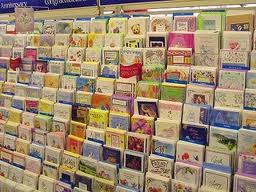
As I organize, and I am using the term rather loosely at the moment, I run into the perpetual issue of cards.

Birthday cards. Valentine’s wishes. Christmas greetings. Sympathy noted. Wedding congratulations. Merely thinking about you missives.

Cards coming out the ying-yang here and some going back years.

I even have a gift sack full of sympathy cards from my late husband’s visitation that I ransacked for cash and abandoned – unread for the most part and most definitely never responded to. Cue Miss Manners her tongue cluck.

“What should I do with them?” I asked Rob. “Someone paid money for them.”

I think it’s the money spent that stops my hand at the shredder more than the thoughts or motives behind the mailing of them.

Not long ago, I bought a mess of the darn things myself at the grocery. Summer birthday wishes and Father’s Day.

“Look at these!” exclaimed the cashier. “Cards! I haven’t checked any through in I can’t remember when. People just don’t send this stuff anymore.”

I felt like a relic. An antique who hordes them as well as perpetuates their tribble like accumulation in society.

“Well,” Rob said in response to my query, “I can’t help you. I have a bunch of yours myself.”

Now I am slightly offended. Of course you have mine!

“I keep yours!”

“Why?”

“Because you gave them to me and you wrote little notes in them,” I said, snuggling under his chin.

And there is the crux of the matter.

I keep cards and notes of those I hold dear and consider the paperstock of others to be no better than unsolicited junk mail.

However, I can’t keep every card that is sent to me, my daughter or Rob and I. There is an “enough” point and I have reached it. The problem is to avoid the whole “guilt” thing. And it’s tricky.

For example, I feel not the tiniest bit of guilt for not responding to the sympathy cards that are sitting still in that sack, but I feel guilt about throwing them away. The cards themselves mean nothing, but the reason they were sent does. Therefore, the cards endure long after they should have been recycled.

The idiocy of this is not lost on me because not only did I keep them but fifteen months after the fact, I packed them and transported them to another country, where they continue to not be replied to or looked at or do anything other than take up valuable space. Space that is premium – as all space is.

The same can be said of paper in general. We keep far more than is necessary. I have two file folders full of the daily reports that Dee’s daycare kept, recording what she ate, when she slept, and anything of note. I have nearly three years worth of these reports.

Why? Because I stopped journaling her daily activities at the end of the first year. Un-coincidentally this is when her father took quite ill. In my mind, the reports are part of her “baby” record. I was too preoccupied to keep obsessive track of her “firsts” and thought I would go back later and scan the reports for highlights and compile them.

Dee is eight years old. The reports are still in a file cabinet – which also traveled internationally .

The madness!

“I just want to rent a dumpster and pitch everything in without stopping to look at it,” I told Rob.

“Okay,” he agreed. “Let’s.”

It’s not really that irrational a solution. I have, after all, purged an entire house of possessions. Literally given away thousands of dollars in furnishings, clothes and household goods without really blinking or looking back in angst. It’s not so silly an idea.

What is it about paper? Whether it’s words or photos, it’s so much harder to part with.


If you are a Tea Party member in Mason City, Iowa, the commonalities lunge at one like bad 3-D, but to a person who reads, thinks for herself and happens to have paid attention during her early 20th century history class – the question should really be “aside from being political leaders during economically crushing times what do they have in common?”

And even that is stretching it.

The “change” bogeyman is nothing more than a political tool that they all use – Tea Partiers and Mama Grizzlies included -because it works.

Human beings are notorious for their dislike of change. Creatures who seek comfort and who mainly live within the confines of their homes unless some consumer need drives them out to the nearest shopping blight on the landscape, Americans in particular are living change at speeds that the vast majority of them never anticipated and weren’t raised with the coping skills to deal with.

The Tea Party then is little more than an adult temper tantrum about the loss of the American Dream rug beneath their feet. Turns out, that whole myth about us descending from hardy pioneer stock is really just a myth.

The people of Germany and Russia during WWI, which is the breeding ground for both Hitler’s rise and Lenin’s takeover, were dealing with the kinds of economic devastation the likes of which would send most Americans in search of corners to curl up in. To compare our current recession to children literally starving to death, as they were in Russia at the end of the first world war, is the height of self-absorption.

To their credit, the main body of the Iowa Tea Party disapproves of the Mason City billboard.

Yes, it’s a billboard, and it’s up for the coming month in Mason City, so feel free to mock and jeer across the blogosphere, but don’t expect it to have any effect on their views.

I know the kinds of people who fall for this type of logic. I grew up next door to them in the northeast part of the state. I taught their kids for twenty years in the public school system in the center of the state. Decent enough folk, they lead with their bellies and their sense of entitlement and a recession like the one we are experiencing unnerves them. Why? Because it flies in the face of everything we Americans are taught to trust. Behave, work hard and the middle class dream is yours.

A dream that Obama favors by the way and that Lenin would have curled a lip at.

I won’t argue with the smaller print that “radical leaders prey on the fearful and naive” but I will note the irony. And the fact that the irony would be so lost on the people who designed this billboard.

UPDATE: After being up for just one week, the Mason City Tea party billboard has been covered up at the request of the group who received hundreds of threatening messages from irate Mason City folk – who apparently all know there history better than the Tea Party people. No apology was issued and the group’s spokesperson insists that people misunderstood the billboards main idea. Um … sure, dude.

Photo by Deb Nicklay/Mason City Globe Gazette