cleaning and organizing


Oil painting of a scullery maid by Jean-Simèon...

Image via Wikipedia

There is a reason why women abandoned the kitchen in droves once the combined effects of modern conveniences and access to the workplace kicked in. And that reason?

Kitchens are the equivalent of salt mines. Backache inducing, mind-mushing and mostly unappreciated work.

Subtracting the last bit for myself personally because my husband appreciates enormously and often, the aching back and low-level of intellectual stimulation will not induce many of my gender back to the scullery no matter how Home Depot dresses it up.

Today I baked, laundered, raked and tidied.

For hours.

And I am not a pioneer homemaker or even my Grandmother. Despite my personal fetish of mixing up foodstuff from scratch, my wifely arsenal includes an industrial mixer, an oven that doesn’t require the need to stoke it with wood (that would need to be chopped), a microwave, a blender, a food processor and a dishwasher (which praise be to my husband is installed and in service again). And still, the morning and a goodly chunk of afternoon later saw me just finishing and not even close to cleaning or yard-work.

Here’s where the feminists – married some, but mostly single – chime in, “Where is your husband? Division of labor violation alert!”

But he was mixing cement and applying scratch coat to the sides of the house, and seriously, labor division is an illusion. Always was and continues to be this fantasy that ruins more relationships than it should.

Reality is that Rob tends to the big house things – like siding, roofing, knocking out walls, installing hardwood and all things mechanical, electrical and plumbing related. I make the trains run on time, which isn’t glamorous or easy to point a finger directly at most days but necessary none the less.

And I teach yoga. Which is fun and good for me besides while Rob girds up to head back to literally dig a salt mine at a nearby chemical plant. It is neither fun nor good for him – as his recent heart attack attests to.

The point then? There isn’t one aside from the obvious, which is that fair is an ebb/flow thing, and when one gets all bean-counterish about it – joy is naturally sucked right out of one’s  existence.

There is nothing overwhelmingly odious about modern life that probably isn’t self-inflicted by unrealistic expectations that are imposed on us from the outside.


If I were going to write a memoir, that’s what I’d call it and then subtitle it with – Lather, Rinse and Repeat.

I bring this up for two reasons.

The first is that my blog reader is crammed with Eat, Pray, Love crap as the Julia Roberts adaptation of Elizabeth Gilbert’s book is opening or has opened.

The reviews are mostly “meh”. No surprise. The novel itself isn’t much. One review pronounced it too “talk-y” as in the character constantly describes how she feels and her observations about every freaking thing. As if a movie about a writer documenting her journey to enlightenment should be somehow more visual than word-packed.

My favorite review so far was written by Helena Andrews at The Root. It took up the theme of Gilbert’s book and named it “white girl problems”. Couldn’t have found a better genre for it.

White girl problems are essentially the non-issues the pale and the privileged focus on in the absence of actual adversity.

When I attempted to read Eat, Pray, Love, Will was just going into hospice. A book by a woman bemoaning her serial monogamy – that horrid pretty girl issue of having always been someone’s girlfriend or wife – while I was losing the only man I’d ever had a long-term relationship with in my entire 41 years didn’t go over well.

Sucks to be her, I mentally eye-rolled as I put the book on a shelf never to be cracked open again until I decided that some of her syrupy half-wit might be useful when I was writing comps for my education masters about six months later. I knew Gilbert was a poser but my professor didn’t.

Andrews though draws this awesome comparison between “white girl problems” lit/memoirs and a line from Tim Burton’s Alice in Wonderland. There is a scene where the Mad Hatter observes that in the real world, Alice has lost her “muchness”.

“You were much more … muchier.”

White girls in the real world then are searching for their muchness.

Gilbert’s muchness turned out to be the exact thing she thought was her problem – love and being in a relationship – because her journey ends when she meets the man she is now married to.

So much for issues.

Which brings me to my second reason, and it is related to the loss of muchness. My memoir. The one that’s pretty much written and is screaming to be edited and shopped.

I can’t.

I know. I have been saying that for a while now, but I am sure of the reason behind my reluctance. And it goes beyond my belief that books about overcoming tragedy by being plucky, witty and boot-strappy are so common place that they’ve become clichés onto themselves.

Rob followed a link to a widow blog and the author was describing her experiences at a Blogher style convention for widows complete with keynote speakers, author panels and how-to workshops. A couple of her encounters with people who’d mined literature from their experiences and turned them into books and/or workshops had left her feeling removed and as though she was possibly doing widowhood and grieving wrong.

And then I knew why I haven’t finished my memoir.

I can’t give people their muchness back. I could write a memoir, package it and sell it out of workshops and conventions, but a person’s muchness comes from within not from without.

I felt/still feel sometimes as though I didn’t do widowhood right. The way I felt, and the things I needed to do for myself, were often so out of step with other widows, books on grieving and even memoirs of widows that I wondered how I could be so far out in the weeds when everyone else seemed to know where the paved road was.

I can’t do that to someone else. Lead them to believe – even inadvertently – that I know the way.

Especially since I really don’t believe there is a process to grief or a one size fits all way to navigate the first year or that the whole honoring of someone’s memory should even be numbered in the top twenty of a person’s priority list.

The blogger mentioned how pleased some of the authors seemed with themselves, their lives and this opportunity to basically headline a conference. And I can totally understand her and them.

It’s amazing when people read what you’ve written and tell you it meant something to them. It would be easy to let that dominate and forget that the subject matter makes you more responsible to your readers than that of a fiction writer.

If what I write inspires someone, wow, but if it makes someone feel inadequate, wrong, or persecuted by the fates? Ouch. It would bother me the same way that the kid in my 3rd hour English class who’d given up because he’d never gotten a grade above a D used to bother me. Even though that wasn’t really my fault, I had to fix it. It was my job.

Memoirists open their lives for reasons that are far different from that of a fiction writer. It’s more than telling a good story. My story and opinions as a blueprint for grieving would be a responsibility like the one I took on as a teacher. And it would mean never fully closing the door. The pain would always have access of sorts to my now. A liberty that it doesn’t deserve and that I don’t owe it.

Besides, I’ve written my story – here and in a hundred different places all over the webosphere via comments and guest posts.

Purge, Pack and Move would be an awesome title though.  Sigh.


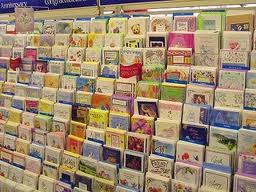
As I organize, and I am using the term rather loosely at the moment, I run into the perpetual issue of cards.

Birthday cards. Valentine’s wishes. Christmas greetings. Sympathy noted. Wedding congratulations. Merely thinking about you missives.

Cards coming out the ying-yang here and some going back years.

I even have a gift sack full of sympathy cards from my late husband’s visitation that I ransacked for cash and abandoned – unread for the most part and most definitely never responded to. Cue Miss Manners her tongue cluck.

“What should I do with them?” I asked Rob. “Someone paid money for them.”

I think it’s the money spent that stops my hand at the shredder more than the thoughts or motives behind the mailing of them.

Not long ago, I bought a mess of the darn things myself at the grocery. Summer birthday wishes and Father’s Day.

“Look at these!” exclaimed the cashier. “Cards! I haven’t checked any through in I can’t remember when. People just don’t send this stuff anymore.”

I felt like a relic. An antique who hordes them as well as perpetuates their tribble like accumulation in society.

“Well,” Rob said in response to my query, “I can’t help you. I have a bunch of yours myself.”

Now I am slightly offended. Of course you have mine!

“I keep yours!”

“Why?”

“Because you gave them to me and you wrote little notes in them,” I said, snuggling under his chin.

And there is the crux of the matter.

I keep cards and notes of those I hold dear and consider the paperstock of others to be no better than unsolicited junk mail.

However, I can’t keep every card that is sent to me, my daughter or Rob and I. There is an “enough” point and I have reached it. The problem is to avoid the whole “guilt” thing. And it’s tricky.

For example, I feel not the tiniest bit of guilt for not responding to the sympathy cards that are sitting still in that sack, but I feel guilt about throwing them away. The cards themselves mean nothing, but the reason they were sent does. Therefore, the cards endure long after they should have been recycled.

The idiocy of this is not lost on me because not only did I keep them but fifteen months after the fact, I packed them and transported them to another country, where they continue to not be replied to or looked at or do anything other than take up valuable space. Space that is premium – as all space is.

The same can be said of paper in general. We keep far more than is necessary. I have two file folders full of the daily reports that Dee’s daycare kept, recording what she ate, when she slept, and anything of note. I have nearly three years worth of these reports.

Why? Because I stopped journaling her daily activities at the end of the first year. Un-coincidentally this is when her father took quite ill. In my mind, the reports are part of her “baby” record. I was too preoccupied to keep obsessive track of her “firsts” and thought I would go back later and scan the reports for highlights and compile them.

Dee is eight years old. The reports are still in a file cabinet – which also traveled internationally .

The madness!

“I just want to rent a dumpster and pitch everything in without stopping to look at it,” I told Rob.

“Okay,” he agreed. “Let’s.”

It’s not really that irrational a solution. I have, after all, purged an entire house of possessions. Literally given away thousands of dollars in furnishings, clothes and household goods without really blinking or looking back in angst. It’s not so silly an idea.

What is it about paper? Whether it’s words or photos, it’s so much harder to part with.