American Life


Sarah Palin committed a bush in a recent Twitter battle cry to New Yorkers calling them to “refudiate” plans to build a mosque close to the 9/11 site.

“Refudiate” is, of course, not a real word in the same that “normalcy” was not a real word until President Warren G. Harding coined it a hundred years ago – give or take.

The offense against the American version of the English language was quickly seized upon by those who (quite rightly) fear Palin and held it up as proof of her already rather obvious lack of dexterity with a language we can only assume she’s been speaking since toddlerhood.

Although malapropisms out of the mouths of political leaders actual and wanna be are disheartening, out of the mouth of Palin, it’s not worth a footnote much less a bloggy storm.
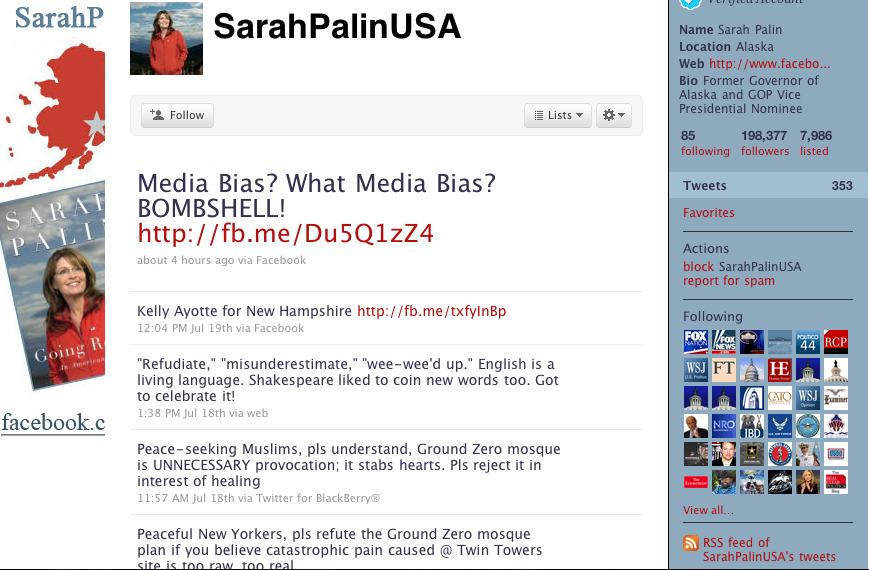
What’s really eye-opening came on the heels of Mama Sarah’s predictable inability to be chagrined.

“Shakespeare liked to coin words too.” she twittered back at the elitist blogosphere.

And indeed he did.

All that glitters is not gold. As (good) luck would have it. Household words. Cold comfort. In a pickle. Devil incarnate. Eaten me out of house and home. For goodness sake. Give the devil his due. Heart of gold. Laughing stock. It was Greek to me. Naked truth. Wild goose chase.

What amazes me and seems to have sailed past everyone’s offended ears is that Sarah Palin knows that Shakespeare coined words and phrases that previously didn’t exist in the English language.

And I will concede that it’s very possible that her little Twuip was as ghostwritten as her book, but it was clever, and it’s past time her critics realized that she cannot be mocked and jeered away.

First, because Palin doesn’t blush unless it will serve a greater purpose.

Second, she has a gift for turning faux pas into the “aw shucks, I’m just folk like you ordinary people”. She spins her legend from the ridicule and frustrated rants of the left and the few on the right who see the damage she is doing to their politics – such as they are.

Refudiate? I think ole Will could have done better. The things that man could have done with a Twitter stream should leaving us weeping over the drivel that reigns as literary there now.

It’s not the worst thing she’s uttered in any medium, but it’s important to remember that she can’t be taken down by trivial nit-picking. She feeds on that like Nosferatu on village virgins.

Substance, people. She doesn’t have any. Criticism of her should.


If you are a Tea Party member in Mason City, Iowa, the commonalities lunge at one like bad 3-D, but to a person who reads, thinks for herself and happens to have paid attention during her early 20th century history class – the question should really be “aside from being political leaders during economically crushing times what do they have in common?”

And even that is stretching it.

The “change” bogeyman is nothing more than a political tool that they all use – Tea Partiers and Mama Grizzlies included -because it works.

Human beings are notorious for their dislike of change. Creatures who seek comfort and who mainly live within the confines of their homes unless some consumer need drives them out to the nearest shopping blight on the landscape, Americans in particular are living change at speeds that the vast majority of them never anticipated and weren’t raised with the coping skills to deal with.

The Tea Party then is little more than an adult temper tantrum about the loss of the American Dream rug beneath their feet. Turns out, that whole myth about us descending from hardy pioneer stock is really just a myth.

The people of Germany and Russia during WWI, which is the breeding ground for both Hitler’s rise and Lenin’s takeover, were dealing with the kinds of economic devastation the likes of which would send most Americans in search of corners to curl up in. To compare our current recession to children literally starving to death, as they were in Russia at the end of the first world war, is the height of self-absorption.

To their credit, the main body of the Iowa Tea Party disapproves of the Mason City billboard.

Yes, it’s a billboard, and it’s up for the coming month in Mason City, so feel free to mock and jeer across the blogosphere, but don’t expect it to have any effect on their views.

I know the kinds of people who fall for this type of logic. I grew up next door to them in the northeast part of the state. I taught their kids for twenty years in the public school system in the center of the state. Decent enough folk, they lead with their bellies and their sense of entitlement and a recession like the one we are experiencing unnerves them. Why? Because it flies in the face of everything we Americans are taught to trust. Behave, work hard and the middle class dream is yours.

A dream that Obama favors by the way and that Lenin would have curled a lip at.

I won’t argue with the smaller print that “radical leaders prey on the fearful and naive” but I will note the irony. And the fact that the irony would be so lost on the people who designed this billboard.

UPDATE: After being up for just one week, the Mason City Tea party billboard has been covered up at the request of the group who received hundreds of threatening messages from irate Mason City folk – who apparently all know there history better than the Tea Party people. No apology was issued and the group’s spokesperson insists that people misunderstood the billboards main idea. Um … sure, dude.

Photo by Deb Nicklay/Mason City Globe Gazette


Twenty-five per cent of Americans don’t know that the United States won its independence from Great Britain according to a poll conducted by Marist University this last Independence Day weekend.

The Marist poll asked just one question: “On July 4th we celebrate Independence Day.  From which country did the United States win its independence?”

And though 74 per cent of Americans were able to give the correct answer, a disappointing 26 per cent didn’t know with the majority of them saying they were “unsure” of the correct answer.

And those who guessed incorrectly? From whom did they believe Americans liberated themselves?

China. Spain. France. Japan. Mexico.

It gets a bit worse.

Those folks who knew the correct answer were mainly white, earning over $50,000 a year and male. People in the northeast knew their American history better than those in the south (no surprise as they have always been revisionists), and people under 29 would probably benefit from a Wii version of the American Revolution because they were most likely to not know that the United States fought against Great Britain in the epic revolution that led to the holiday we so love to celebrate every July.

Another public education failure?

Maybe.

I don’t really buy into the idea that America was ever a nation of Rhodes Scholars who’ve been dumbed down over recent decades thanks to a fiendish conspiracy of elementary school teachers and a steady diet of insipid television programming.

We were all quite dumb to begin with.

Over the last decade, the study of civics and history of any kind has taken a back seat to those subject areas that are most heavily tested like math and reading. Because only a few subject areas count in the standardized testing game, those that aren’t get shorted. Civics and American history aren’t make or break tests in determining whether a school is a success or failure. When your school’s reading or math scores can push you into a turnaround, that’s where the time and effort goes.

It could also be a byproduct of our television and movies that “re-imagine” historical events with more attention to the entertainment aspect than the facts, and the sad reality that we are a culture of now. If it happened yesterday or last week, it’s old news. In a world were everything is tweeted and updated within seconds, how can anything that happened over 230 years ago matter?

Our public school system came to be not just as a way to warehouse children once they were no longer put to hard labor the moment they could fetch and carry. It existed with the intent of producing a literate citizenry able to participate as members of a democracy. Our nation’s history and the rights and duties of its population were as important to the curriculum as the 3 R’s.

When I was in middle school, I learned some of my American history watching cartoons on Saturday morning. Schoolhouse Rock cartoons ran in between shows and regaled me and my peers with ditties designed to teach us about the American Revolution, The Constitution and how bills became laws. Simple? Yes.  Effective? Very. Over thirty years later, I can still sing along with most of the tunes.

Schoolhouse Rock should remind us that it takes a village to teach our children well, but the first step towards ensuring that future generations are less ignorant about America’s roots might be the unshackling of public education from mindless testing and allowing teachers to get back to all the basics.